
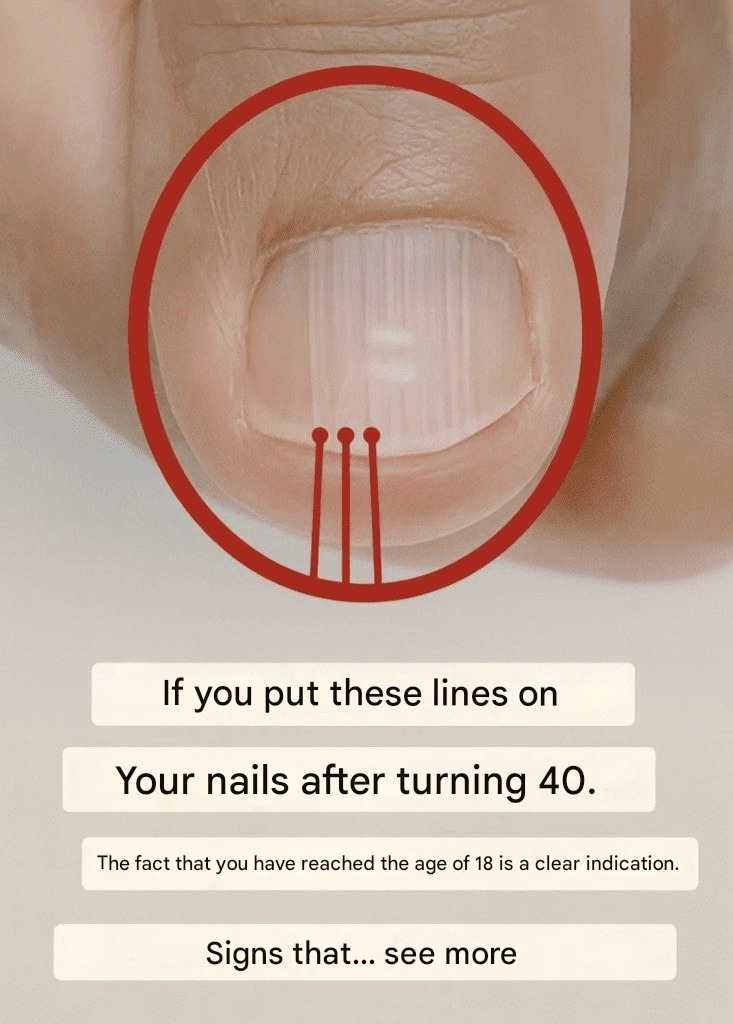
Have you noticed thin, vertical lines running from the root to the tip of your nails as you’ve gotten older? If so, you’re not alone. Many people start noticing these changes after the age of 40. Most of the time, they’re harmless, but in some cases, they can indicate underlying health issues. So what causes vertical ridges—and when should you be concerned?
Understanding vertical nail ribs
Vertical ridges, also called longitudinal lines , are raised lines that extend from the cuticle to the tip of the nail. They can vary in depth and number and often become more visible with age.
Just as skin loses elasticity and hair turns gray, nails also change structurally over time. The production of keratin – the protein that forms nails – can decrease or become uneven, leading to ridges.
Main causes after the age of 40
1. Natural aging process
The most common cause of vertical ridges is simply aging. As we age, our body’s ability to regenerate skin cells decreases. The same happens to the nail matrix (the base of the nail), which can produce keratin unevenly, leading to ridges.
2. Drying out the nail
As we age, nails – like skin – tend to become drier. Lack of moisture makes nails more brittle and accentuates ridges. Frequent contact with water, soap and cleaning chemicals can worsen dryness.
3. Nutritional deficiencies
Low levels of key nutrients like biotin, iron, zinc, and magnesium can weaken nails and make ridges more prominent. Since metabolism and nutrient absorption often slow with age, deficiencies are more common after age 40.
4. Health status
In some cases, vertical lines can indicate underlying health issues, including poor circulation, thyroid imbalances, or rheumatoid arthritis. If you also notice fatigue, brittle hair, or skin changes, it’s worth speaking to a doctor.
When should you start worrying?
Vertical grooves are usually harmless, but you should see a doctor if you notice the following:
-
Changes in nail color (especially dark streaks or lines)
-
Splitting, peeling, or thickened nails
-
Pain, swelling, or inflammation around the nail
These may indicate fungal infections, trauma or – in rare cases – melanoma, a serious form of skin cancer that can occur under the nail.
