
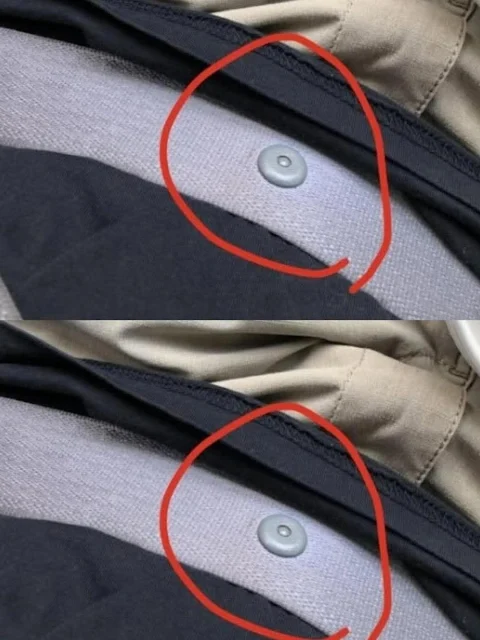
This is the most obvious function. Without that button, every time you unbuckled, the metal latch plate would slide all the way down to the retractor mechanism at the floor or base of the seat.
Imagine: You reach for your seat belt, and the latch plate is buried somewhere near your hip or even lower. You’d have to fish around, pull the webbing up, and hunt for it every single time.
The button stops the plate from sliding down too far, keeping it right where you expect it—within easy reach.
2. It Prevents the Latch Plate from Disappearing
In some vehicles, especially with three-point seat belts, the latch plate can slide all the way down and get stuck or tangled in the retractor mechanism. The button prevents this, saving you from frustration and potential damage to the belt system.
3. It Reduces Noise
Have you ever driven over a bump and heard a rattling sound from your seat belt area? That’s often the latch plate sliding up and down the webbing. The button limits this movement, reducing annoying rattles.
4. It Helps with Proper Positioning
In a crash, the position of the latch plate matters. If it’s too low, it might not distribute forces correctly. The button helps ensure the plate stays roughly where it should be for optimal performance.
Is It Actually Important for Safety?
While the button itself isn’t a primary safety device like the pretensioner or airbags, it plays a supporting role in safety. Here’s why:
-
Quick access matters. In an emergency, you need to be able to buckle up quickly and without fumbling. A latch plate that’s always in the same place helps with that.
-
Proper belt function. If the latch plate slides too far down, it can interfere with the retractor mechanism or cause the belt to twist, potentially affecting how it performs in a crash.
-
Reduced distraction. A rattling seat belt is annoying and can distract you from driving. The button reduces that distraction.
What Happens If It Breaks?
Over time, that little button can wear out, crack, or even fall off. If that happens:
-
The latch plate will slide all the way down when you unbuckle
-
You’ll have to reach down to find it every time
-
It may rattle more
-
In rare cases, the belt could twist or tangle
Is it dangerous? Not immediately. Your seat belt will still protect you in a crash if it’s properly fastened. But it’s definitely annoying, and over time, the constant sliding could cause wear on the webbing or latch plate.
Can You Fix It?
Yes! Replacement buttons are available at auto parts stores or online. They usually snap or screw onto the webbing. Some people even use a zip tie as a temporary fix—just be sure it’s secure and won’t interfere with the buckle mechanism.
Other Little-Known Seat Belt Features
While we’re on the topic, here are a few other seat belt details worth knowing:
The Twist Test
If your seat belt is twisted, it can reduce its effectiveness in a crash. Always make sure the webbing lies flat against your body.
The Height Adjuster
Many cars have an adjustable anchor point on the door pillar. Adjust it so the belt crosses the middle of your shoulder—not your neck or arm.
The Pretensioner
In a crash, this device tightens the seat belt instantly, removing slack and holding you in place. It’s a one-time-use component that must be replaced after deployment.
The Locking Mechanism
If you pull the seat belt all the way out, you may hear a clicking sound. That’s the locking mode, often used to secure child seats. The belt will only retract, not extend, until you let it go all the way back in.
A Small Button With a Big Job
That tiny button on your seat belt is easy to overlook. But like so many small design features, it serves a purpose that makes your daily drive just a little bit better.
So next time you buckle up, give that little button a nod. It’s been quietly doing its job, keeping that latch plate right where you need it, for your entire driving life.
