
The envelope was cream-colored and expensive—the kind my ex-husband Garrett used to say we could never afford. But it wasn’t a bill, or a warning, or another reminder of how broke I was.
It was a wedding invitation.
Garrett was marrying Tessa—the woman he left me for four years ago—and he wanted me there to watch him begin again. Inside was a handwritten note in the same neat script that had once written me love letters and later signed our divorce papers.
No hard feelings. The kids should see both their parents moving forward. Happy.
No hard feelings.
Not about the affair. Not about the divorce. Not about the way he took almost everything and left me with $700 a month, a shattered life, and weekends with my own children.
Then I saw the date.
June 15.
Our anniversary.
He had chosen the day we got married to marry someone else.
That was the moment I decided I would go—but not as the broken ex-wife he thought he had left behind. I would walk into that wedding and show him exactly what he had thrown away.
And I had eighteen months of secrets to help me do it.ana
My name is Rebecca Hartwell, and this is the story of how I arrived at my ex-husband’s wedding with our twins and a man Garrett never saw coming—and how the truth destroyed the perfect life he had built on lies.
Four years earlier, Garrett came home early. I was in the kitchen making spaghetti. Our twins, Evan and Emma, were four, building towers out of blocks on the floor.
He stood in the doorway, loosened his tie, and said the four words that split my life in two.
“We need to talk.”
Then, without warning, “I want a divorce.”
I remember the wooden spoon slipping from my hand. Sauce splattered across the tile.
“Why?” I asked.
“I met someone. Someone who understands me. Someone who gets my ambition.”
Someone younger. Someone prettier. Someone who wasn’t exhausted from raising toddlers.
Her name was Tessa—my friend, a woman who had stood beside us at our wedding.
The divorce that followed was brutal. Garrett’s lawyer was polished and ruthless. Mine was cheap and inexperienced because that was all I could afford. Garrett kept the house, the savings, the retirement accounts—everything carefully arranged so that on paper, I had almost nothing and he had very little more. I’d been a stay-at-home mother, and his side argued that I had no career, no leverage, no real claim.
The judge barely looked at me.
I got crumbs.
After that came four years of survival. Two jobs. Missed sleep. Food bank visits I hid from the twins. Cheap birthday decorations. Shoes I patched instead of replaced. And all the while, Garrett’s mother Patricia never missed a chance to remind me that if I had “taken better care of myself,” maybe her son wouldn’t have strayed.
So when that invitation landed on my kitchen counter, it felt like one more humiliation. One more carefully chosen wound.
But that same day, my laptop chimed with another email from Julian.
Julian.
The man I had met eighteen months ago when I spilled coffee all over his laptop in a café. The man who laughed instead of getting angry. The man I didn’t realize was a billionaire tech founder until our fifth date, when someone recognized him. The man who accepted my need for secrecy because I was terrified Garrett would find out, drag me back to court, and use Julian’s money to hurt me all over again.
Julian had waited. Patiently. Quietly. Without complaint.
Then, that afternoon, a courier delivered a confidential package to my apartment.
Inside were legal documents, bank records, hidden accounts, asset transfers, shell arrangements, and proof—clear, undeniable proof—that Garrett had lied during our divorce. He had hidden money, concealed properties, buried income, and structured deals through other people, including his mother.
At the bottom was a note from Marcus Caldwell, Garrett’s business partner.
I should have spoken up four years ago. I was a coward. I documented everything. I’m sorry it took me this long. This is enough to reopen your case.
And beneath that was a note from Julian.
You don’t have to hide us anymore. Let me stand beside you. You deserve to walk into that room like you own the world. Because you do.
I sat on the kitchen floor, surrounded by proof and pain and possibility.
Then I called my sister.
Diane arrived like a storm. She read the invitation, then the evidence, and looked at me with blazing eyes.
“He invited you to his wedding on your anniversary?”
“Yes.”
After that came four years of survival. Two jobs. Missed sleep. Food bank visits I hid from the twins. Cheap birthday decorations. Shoes I patched instead of replaced. And all the while, Garrett’s mother Patricia never missed a chance to remind me that if I had “taken better care of myself,” maybe her son wouldn’t have strayed.
So when that invitation landed on my kitchen counter, it felt like one more humiliation. One more carefully chosen wound.
But that same day, my laptop chimed with another email from Julian.
Julian.
The man I had met eighteen months ago when I spilled coffee all over his laptop in a café. The man who laughed instead of getting angry. The man I didn’t realize was a billionaire tech founder until our fifth date, when someone recognized him. The man who accepted my need for secrecy because I was terrified Garrett would find out, drag me back to court, and use Julian’s money to hurt me all over again.
Julian had waited. Patiently. Quietly. Without complaint.
Then, that afternoon, a courier delivered a confidential package to my apartment.
Inside were legal documents, bank records, hidden accounts, asset transfers, shell arrangements, and proof—clear, undeniable proof—that Garrett had lied during our divorce. He had hidden money, concealed properties, buried income, and structured deals through other people, including his mother.
At the bottom was a note from Marcus Caldwell, Garrett’s business partner.
I should have spoken up four years ago. I was a coward. I documented everything. I’m sorry it took me this long. This is enough to reopen your case.
And beneath that was a note from Julian.
You don’t have to hide us anymore. Let me stand beside you. You deserve to walk into that room like you own the world. Because you do.
I sat on the kitchen floor, surrounded by proof and pain and possibility.
Then I called my sister.
Diane arrived like a storm. She read the invitation, then the evidence, and looked at me with blazing eyes.
“He invited you to his wedding on your anniversary?”
“Yes.”
“And he wrote ‘no hard feelings’?”
“Yes.”
Diane dropped the invitation onto the counter like it was contaminated. “Please tell me you’re not going.”
I looked at the invitation. Then the papers. Then my sister.
“I think I am.”
That was the first time in four years I smiled—and it wasn’t a soft smile. It was the kind that comes right before a woman stops apologizing for her existence.
I told Diane about Julian. About how serious it had become. About how terrified I still was to trust anyone after Garrett. Diane listened, then said the thing I needed to hear.
“You are not the problem. Garrett just taught you to think you were.”
I cried then. Really cried. Years of swallowed grief came out all at once. When I could finally breathe again, Diane poured me fresh coffee and said, “You have two choices. Reopen the case and drag him through court. Or go to that wedding and let him see what he threw away.”
I looked at her.
She grinned. “Actually, forget that. Do both.”
So I texted Julian.
I’m ready. No more hiding.
His response came in less than a minute.
I was hoping you’d say that.
That night he came over. He brought wine. I kissed him before he was even fully inside the apartment. We talked for hours—about trust, fear, the kids, the wedding, and what came next. When I accused him of investigating Garrett without asking me first, he admitted it with surprising humility.
“I knew you’d tell me not to,” he said. “I also knew you deserved the truth.”
He was right.
A few days later, we introduced him properly to the twins. I was terrified. Garrett had already planted poison in their ears—telling them no one else would ever want me, that I had “let myself go,” that I was lazy. Hearing my eight-year-old children repeat those words almost broke me.
But Julian was steady.
He took them to the park, pushed Emma on the swings, played basketball with Evan, listened to their stories as if nothing in the world mattered more. He didn’t try to buy their affection or pretend to be their father. He was simply present.
That night Emma climbed into my bed and whispered, “I like Julian. He makes you do real smiles.”
The next morning Evan asked, “If you marry him someday, do we have to call him Dad?”
“No,” I said immediately. “Never. He’ll just be Julian.”
Evan nodded. “Good. Because Dad can be mean. But he’s still Dad.”
Children always see more than we think.
As the wedding got closer, Garrett started calling.
First, to make sure I was still coming.
Then, to tell me he understood if I couldn’t afford proper formalwear.
Then, to fish for information about Julian so he could figure out whether he had grounds to reduce child support.
Every word out of his mouth was dressed up as concern and sharpened into insult. But this time, I heard him clearly. Not as a god whose approval I had failed to earn. Just a small, controlling man who couldn’t stand losing power.
Meanwhile, my lawyer reopened the case. The evidence was overwhelming.
Then an unexpected ally appeared.
Patricia—my former mother-in-law—asked to meet me. Diane came with me, ready for war. Instead, Patricia sat across from us looking ten years older than I remembered and said words I never thought I’d hear.
“I owe you an apology.”
She admitted she had pushed Garrett toward Tessa. She thought Tessa’s wealth and connections made her a better match. She admitted Garrett’s business was failing and that the wedding was, in many ways, a financial arrangement built on lies. Then she handed me more evidence—texts, emails, statements—everything she had.
“Use it,” she said. “Stop him. Don’t let him do to Tessa what he did to you.”
I took the folder with shaking hands.
By then, the plan was set.
Marcus would approach Tessa’s father, Richard Brightwell, during the reception and show him the full truth: Garrett’s financial fraud, hidden liabilities, business deception, and the lies that underpinned the marriage itself.
I wasn’t going to make a scene.
I was just going to stop protecting a lie.
The night before the wedding, I had a panic attack on the bathroom floor.
All the old voices came back at once.
What if Garrett was right about me?
What if I was using Julian?
What if this ruined everything?
What if the kids got hurt?
What if I wasn’t strong enough?
Julian texted me at exactly the right moment.
Can’t sleep either. Thinking about you. Proud of you.
When I told him I was terrified, he called.
He didn’t give me grand speeches. He gave me facts.
“You survived four years of hell. You raised two amazing kids. You rebuilt your life from nothing. Strength isn’t the absence of fear. It’s moving anyway.”
I listened to him breathe until my own breathing steadied.
In the morning, Diane arrived with coffee, pastries, and the energy of a woman preparing for battle. She did my hair, makeup, nails—everything. Then she zipped me into an emerald-green dress, the very color Garrett once told me made me look washed out.
I looked in the mirror and saw myself again.
See more on the next page
Advertisement
Not the woman who begged to be enough.
Me.Julian arrived at one in the afternoon in a dark suit and froze when he saw me.
“You’re stunning,” he said.
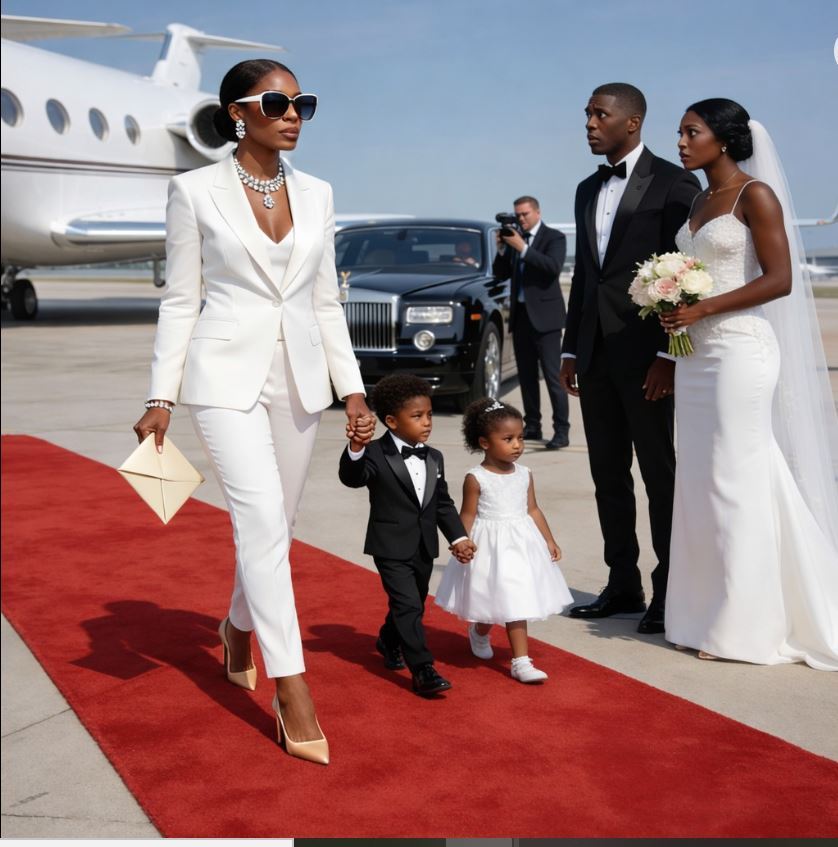
The twins came out dressed beautifully too, and together we drove to a private airport.
The jet was Julian’s.
The children were ecstatic. I was nauseous.
By the time we landed and the black SUVs pulled up to Garrett’s venue—a sprawling estate with white flowers, crystal chandeliers, and all the wealth he once swore we could never touch—I had gone strangely calm.
We stepped out one by one.
People stared.
The whispers started instantly.
Is that Rebecca?
Who’s that with her?
Is that Julian Ashford?
Did they come on a private jet?
I stood taller.
Garrett’s wedding planner hurried over in confusion because he had only put my name on the guest list, not the twins, not any guests. Julian spoke in that quiet, effortless way powerful men do when they never need to raise their voices.
“I’m sure something can be arranged.”
It was.
Inside, even Patricia smiled when she saw me.
Then the ceremony began.
Garrett walked to the altar full of confidence—until he looked toward the back and saw me.
Saw the children.
Saw Julian.
I watched shock rip through him, followed by anger, then calculation.
Good.
Tessa came down the aisle radiant and oblivious, and for the first time in years I felt no jealousy. Only pity. She still had time to escape.
The ceremony moved on, but Garrett kept glancing back at me, distracted, unsettled. His voice shook slightly during the vows.
Afterward, at cocktail hour, he approached.
“You came,” he said.
“You invited me.”
His eyes flicked to Julian. “I didn’t know you were bringing anyone.”
“You said the kids should see both parents moving forward. This is what moving forward looks like.”
Julian offered his hand. “Julian Ashford. Pleasure.”
Garrett recognized the name. I watched it hit him.
“How long?” he asked.
“Eighteen months,” I answered.
The children met Julian the week before. Garrett looked as if he had been slapped in public. He muttered something about custody and support.
“Not here,” I said. “Not today. Enjoy your wedding.”
And I walked away.
Diane nearly vibrated with satisfaction.
Dinner came. Speeches came. Tessa’s father proudly welcomed Garrett into the family and spoke about their business future.
Then Marcus made his move.
He asked Richard Brightwell aside and showed him everything.
For nearly an hour they were gone.
When Richard returned, his face was stone.
He went straight to Tessa and pulled her aside. He showed her something on his phone. Her face drained of color. She looked from the screen to Garrett as if seeing him for the first time.
Then Richard stood and made an announcement.
“There’s been a family emergency. The bride and her family need to leave.”
Gasps rippled through the room.
Tessa walked past Garrett without touching him.
He tried to follow.
Her father blocked him.
And there, in the middle of the glittering reception he had built to display his victory, Garrett stood abandoned, exposed, and finally alone.
We gathered our things and headed for the exit. But Garrett caught up to us first.
“What did you do?” he hissed.
I looked him straight in the eye.
“I told the truth.”
“You ruined my wedding!”
“No. You ruined your wedding. You lied to everyone. I just stopped covering for you.”
Then he looked at Julian and said the words I never expected to hear.
“I made a mistake. With you. I see that now.”
For a heartbeat, the old me might have been satisfied by that confession.
But the woman I had become felt only clarity.
“I know,” I said. “But that’s your burden now. Not mine.”
Then I walked away.
I didn’t look back.
The next morning, Tessa called me.
She had gotten my number from Garrett’s phone.
She thanked me.
Her father had shown her everything—the fraud, the hidden money, the lies, the same pattern I had tried to warn her about years earlier. She told me she was sorry for what she had done to me. Sorry for helping destroy my marriage. Sorry for believing she was special.
I told her the truth.
“He doesn’t love people. He uses them.”
She cried. Then she thanked me again for saving her from wasting more years of her life.
Three months later, the reopened divorce case settled.
I got what I should have received four years earlier: a fair division of assets, increased support, proper legal recognition of everything Garrett hid, and a new custody arrangement. His lawyers fought, but the evidence was too much.
He lost his standing in his company.
His business collapsed around him.
Marcus stayed and helped rebuild what could be saved.
Patricia, awkwardly but sincerely, kept trying to make peace.
And me?
I quit my second job. I moved into a brighter apartment. Then later, into a house of my own. The twins adjusted well. Julian became a real part of our lives—never “Dad,” always Julian, exactly as it should be.
One morning, months later, another cream envelope arrived.
This time it wasn’t a wedding invitation.
It was a full settlement offer from Garrett, along with a handwritten apology.
He admitted I had been right. He admitted he had been wrong. He said he was trying to be better for the children.
I read it once, set it aside, and looked around my new home.
Julian was making terrible pancakes.
The twins were arguing over the bathroom.
Sunlight filled the kitchen.
For the first time, Garrett’s opinion meant absolutely nothing to me.
And that was freedom.
A year later, I stood in the kitchen of the house I bought with my settlement. It wasn’t huge or perfect, but it was mine. Three bedrooms, a backyard, sunlight in every room. Emma and Evan were outside playing with a golden retriever named Sunshine. Julian was at the stove, finally capable of making round pancakes. Diane was setting the table. Marcus, Patricia, Jennifer—my lawyer turned friend—and the people who mattered most filled the house with laughter.
At one point, Emma climbed into my lap and asked, “Mom, are you happy?”
I looked around at my loud, imperfect, beautiful life.
“Yes,” I told her. “I really am.”
That night, after everyone left and the kids were asleep, I found myself sitting on the bathroom floor with my back against the tub—the same place where I had once panicked and doubted everything.
This time I cried too.
But they were good tears.
Julian sat down beside me without asking questions.
“I made it,” I whispered.
“You did more than make it,” he said. “You built it.”
And that was the truth.
The best revenge wasn’t ruining Garrett’s wedding.
It wasn’t the apology.
It wasn’t the settlement.
It wasn’t watching the lie collapse.
The best revenge was discovering I didn’t need revenge anymore.
I needed peace.
I needed love.
I needed my own life back.
And once I saw myself clearly, I realized something that no betrayal, no courtroom, no cruel word could ever take away:
I had always been enough.
