
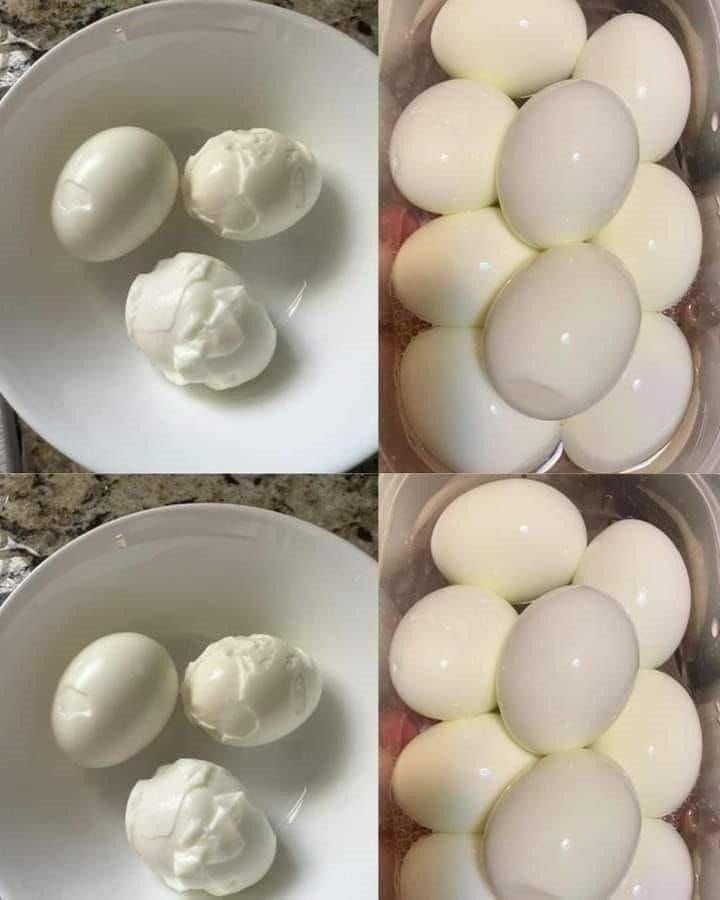
If you’ve ever fought with a hard-boiled egg that refuses to peel cleanly—leaving you with pockmarked, half-moon scraps instead of smooth, perfect whites—you’re not alone. But professional cooks and food scientists have long known a simple, nearly foolproof trick that makes peeling effortless every time.
And it doesn’t involve baking soda, vinegar, or ice baths alone. The real secret? Using older eggs… and peeling them underwater.
The Two-Part Smart Trick
1. Use Eggs That Are 7–10 Days Old
Fresh eggs are harder to peel because their albumen (egg white) has a lower pH, causing it to bind tightly to the inner membrane. As eggs age, air enters through the shell, raising the pH and loosening that bond.
→ Tip: Buy eggs, then wait a week before hard-boiling them for best peeling.
2. Peel Under Running Water or in a Bowl of Water
After boiling and cooling, peel your eggs submerged—either under a gentle stream of cool running water or in a bowl of cold water.
- The water slips between the shell and membrane, acting as a lubricant.
- It also washes away shell fragments before they stick back on.
- Bonus: The agitation helps loosen stubborn bits without tearing the white.
Bonus: The Perfect Boil Method (Chef-Approved)
- Place eggs in a saucepan, cover with cold water by 1 inch.
- Bring to a boil, then immediately remove from heat, cover, and let sit:
- 12 minutes for large eggs
- 10 minutes for medium
- Transfer to an ice bath for 15 minutes (this stops cooking and creates steam pockets between shell and white).
- Peel underwater—starting at the wider end where the air pocket is.
Pro move: Gently shake the eggs in the pot with a little water before peeling—this cracks the shells all over and loosens them instantly!
What Doesn’t Work (Despite the Hype)
- Adding baking soda to water: May make eggs easier to peel slightly, but often leaves a sulfurous taste.
- Poking holes in the shell: Unnecessary and risks cracking during cook.
- Peeling warm eggs: The membrane sticks more when hot. Always chill first!
Why This Works
It’s science, not magic: older eggs + thermal shock (ice bath) + water-assisted peeling = clean, smooth results every time.
So next time you’re making deviled eggs, egg salad, or meal-prep snacks, plan ahead, chill well, and peel in water. Your future self—and your Instagram-worthy deviled eggs—will thank you.
Do you have a go-to egg-peeling trick?
Share it below! And if this saves your next brunch prep, pass it on to a fellow egg lover who’s tired of patchy peels.
